Entry points are not identities
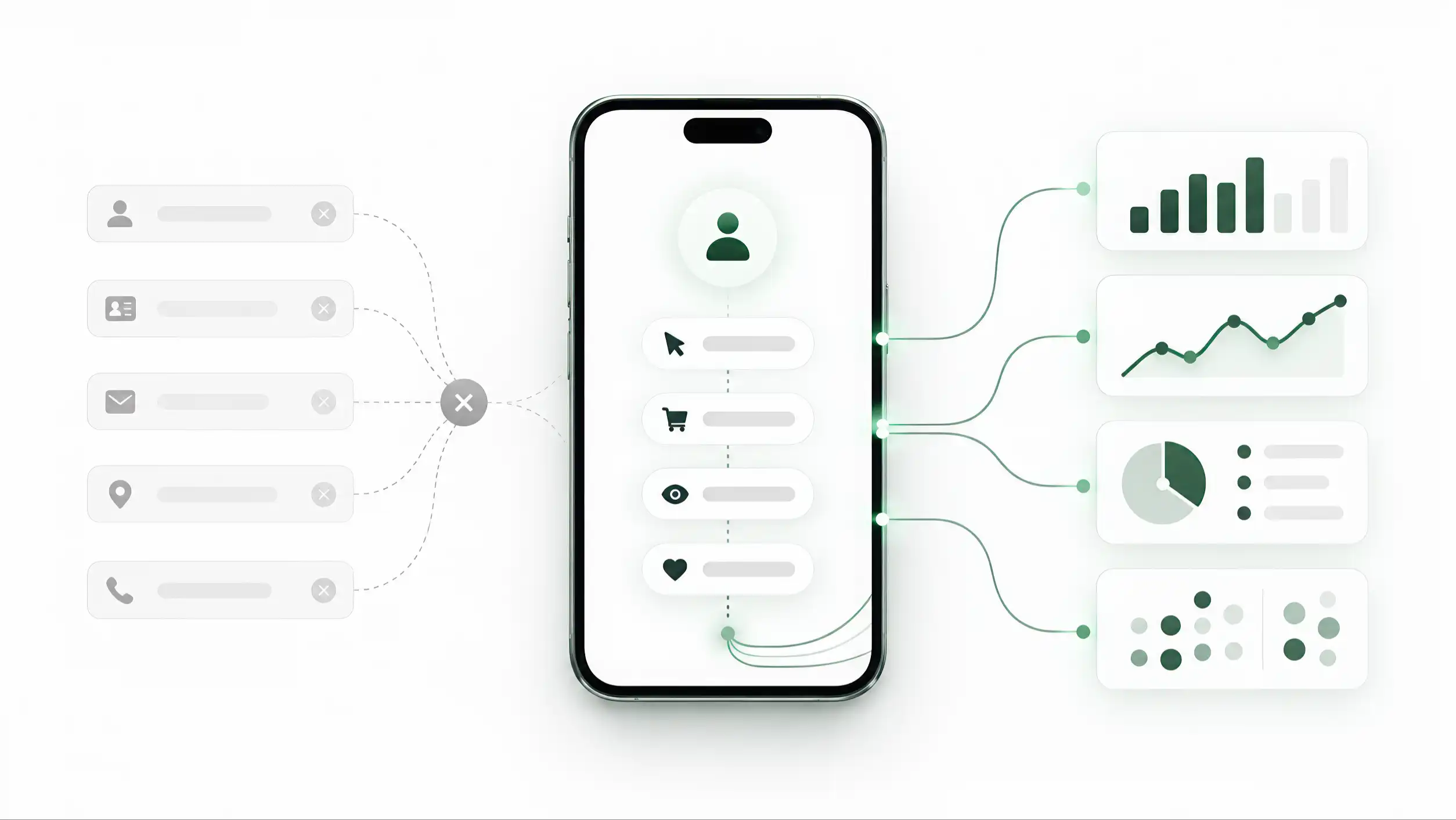
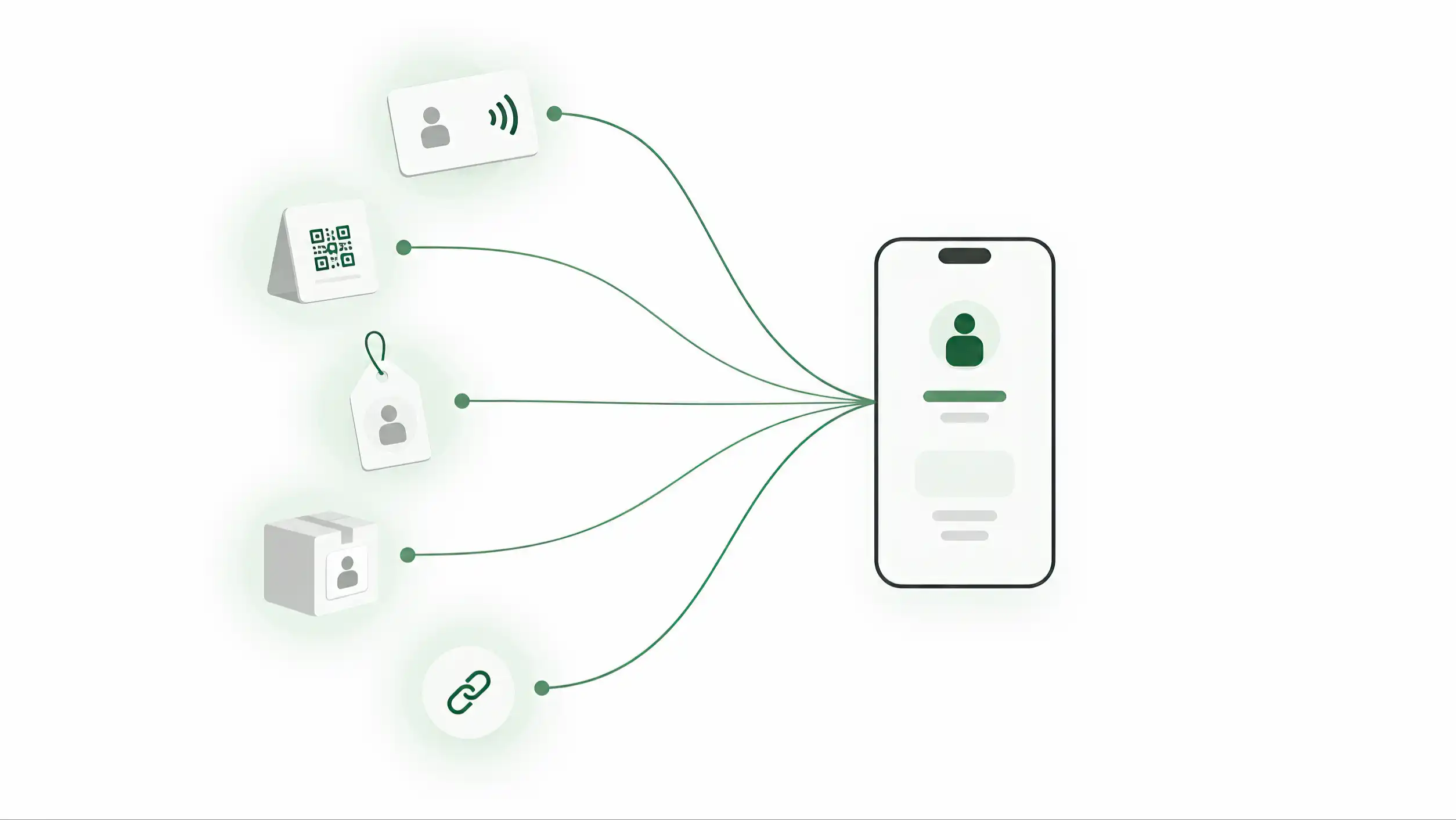
A customer can reach the same business in many ways: tap an NFC business card, scan a QR code on a review stand, open a link from WhatsApp, scan a pet tag, follow a code printed on packaging, or type a direct URL. Those mechanisms are entry points. They describe how a visit begins; they should not automatically create separate versions of the business behind them.
This distinction sounds simple, but it changes the architecture. When every physical product or campaign is treated as its own identity, information starts to fragment. A phone number is corrected in one profile but not another. A job title changes on the business card while the stand still exposes the old role. A service is removed from one landing page but remains on a QR destination created months earlier. Each route may still “work,” yet the customer is no longer reaching one coherent business.
Information architecture provides a useful way to frame the problem. Rosenfeld, Morville, and Arango describe digital environments as places made of information and emphasize coherence across channels. The practical implication is that channel count and identity count should not be confused. A business may have ten entry mechanisms and still maintain one controlled set of core facts.
The core identity is the part that should remain conceptually stable: who the person or organization is, the current public name, approved contact channels, active services, official destinations, language structure, and other facts that should not contradict one another. Entry points sit around that core. They may carry different source context or emphasize different actions, but they should not become independent truths unless there is a genuine business reason to separate them.
This is also consistent with Web architecture. A URI is an identifier for a resource, while the representation returned to a user can change. The identifier, the route used to reach it, and the information shown are related, but they are not the same layer. Treating them as separate concepts makes a system easier to update and reason about.
The operating question is therefore not “How many links do we need?” It is “How many identities are we actually maintaining?” If the same company, person, product, or service is represented across many cards and codes, the default should be one controlled identity with multiple managed entry points. Separate identities should be deliberate exceptions, not accidental by-products of printing another QR code.
One source of truth reduces version drift
Fragmentation rarely arrives as one obvious failure. It develops through ordinary work. A salesperson orders a new card and updates a mobile number there. Marketing creates a campaign landing page and copies the company description from an older profile. A venue installs a review stand. Someone later changes opening hours on the website but forgets the stand destination. Six months later, every piece still appears functional, yet each is exposing a slightly different version of the business.
The architectural answer is a source-of-truth model. Core facts are maintained once, then reused wherever the same identity needs them. This does not require one giant page or one rigid template. It requires clarity about which data is authoritative and which parts are contextual presentation.
A useful split is between shared facts and entry-specific configuration. Shared facts might include the public name, approved logo, primary phone number, official email, social accounts, service catalogue, language versions, legal or company identifiers where relevant, and the active profile owner. Entry-specific configuration can include source ID, campaign label, first-call-to-action, placement, branch context, or the section that should receive initial emphasis.
This distinction prevents “version drift”: the gradual divergence of copies that once matched. The business should not have to remember every printed object whenever a core fact changes. Instead, a change to the controlled identity should propagate to the places that depend on that fact, while contextual settings remain intact. A review stand can still open with reviews emphasized; a business card can still prioritize contact; both can show the same current phone number and business identity.
Centralization also reduces the cost of correction. If the wrong number appears in one source-of-truth record, the team has one problem to fix. If the same number has been copied into twenty destinations, the team has twenty possible defects and no guarantee that all of them are known. The maintenance burden grows faster than the number of links because staff must also remember ownership, purpose, and publication history for each copy.
A source of truth should not become a single point of uncontrolled power. It needs permissions, change history, and clear ownership; those governance questions appear later in this article. The important architectural point here is narrower: reuse stable facts rather than duplicating them.
The system should also make exceptions explicit. A branch may genuinely need a different phone number. A product-specific tag may need different safety information. A temporary event may need a different campaign message. Those are not failures of unification; they are intentional variations. The danger begins when the system cannot tell the difference between a deliberate override and an old copy that simply stopped receiving updates.
Unified does not mean identical
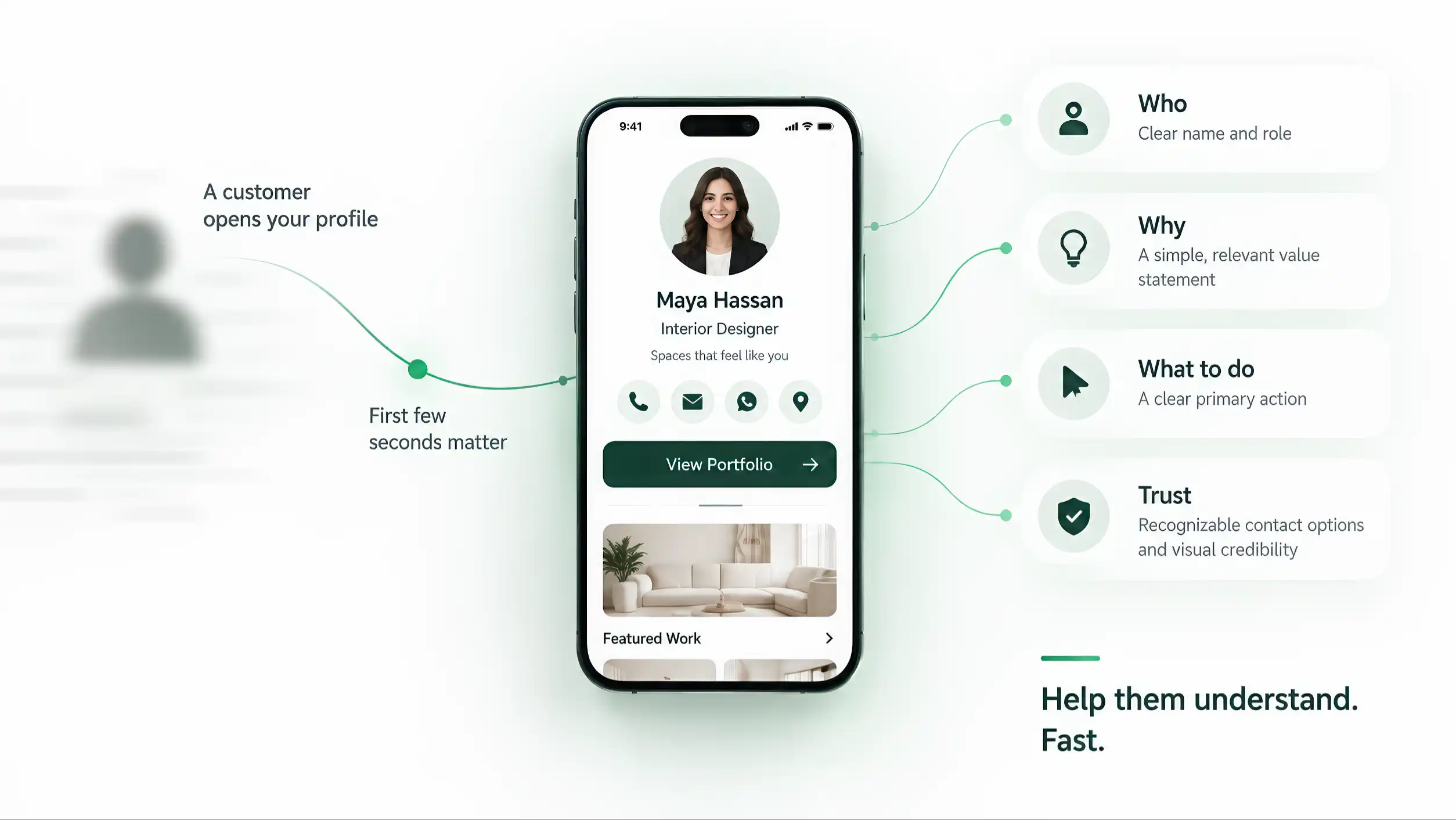
A unified identity should not force every visitor into an identical first screen. The reason someone arrived is part of the experience. A guest scanning a review stand is not in the same moment as a person tapping a networking card. A customer scanning a menu stand is different again. A pet tag may be opened in an urgent situation where owner contact should dominate everything else.
The useful model is therefore shared identity plus context-aware presentation. The identity answers “Who or what is this?” The entry context helps answer “What is the most useful next action here?” Keeping those questions separate avoids a false choice between consistency and relevance.
Consider four physical products belonging to one business. The business card may open the profile with contact and save-contact actions first. A review stand may open the same identity but place the review route at the top. A services stand may lead with current services, booking, or menu content. Packaging may lead with product support, instructions, or reorder information. The customer should still recognize the same organization, see the same current core facts, and move through the same trusted domain or identity system.
This is where information architecture becomes more than navigation. The system needs a model for inherited content and contextual overrides. The entry point should be allowed to influence emphasis without creating a forked copy of the whole profile. In practice, that might mean storing one profile identity and letting each entry point carry a source type, preferred landing section, campaign context, or action priority.
The rule is that contextualization should be reversible and inspectable. An operator should be able to see why a particular stand opens with reviews first and change that behavior without editing the underlying identity. If a campaign ends, removing the campaign emphasis should return the visitor to the normal profile rather than leaving an abandoned duplicate page.
Consistency should also survive language changes. Arabic and English versions can be written naturally for their audiences, but the underlying identity, available actions, service status, and ownership should remain aligned. Context-specific presentation should not become an excuse for one language to drift away from the other.
A visual system can support this architecture. The brand, identity cues, navigation logic, and trust signals remain familiar while the first action changes with the entry context. That is closer to how people expect a coherent system to behave: the same organization recognizes where they came from and adapts the starting point without pretending to be a different organization.
The design goal is not identical pages. It is predictable identity with relevant entry behavior.
Alt text EN
Several distinct entry points converging on one shared identity, then presenting different first actions according to context
Consistency is operational, not cosmetic
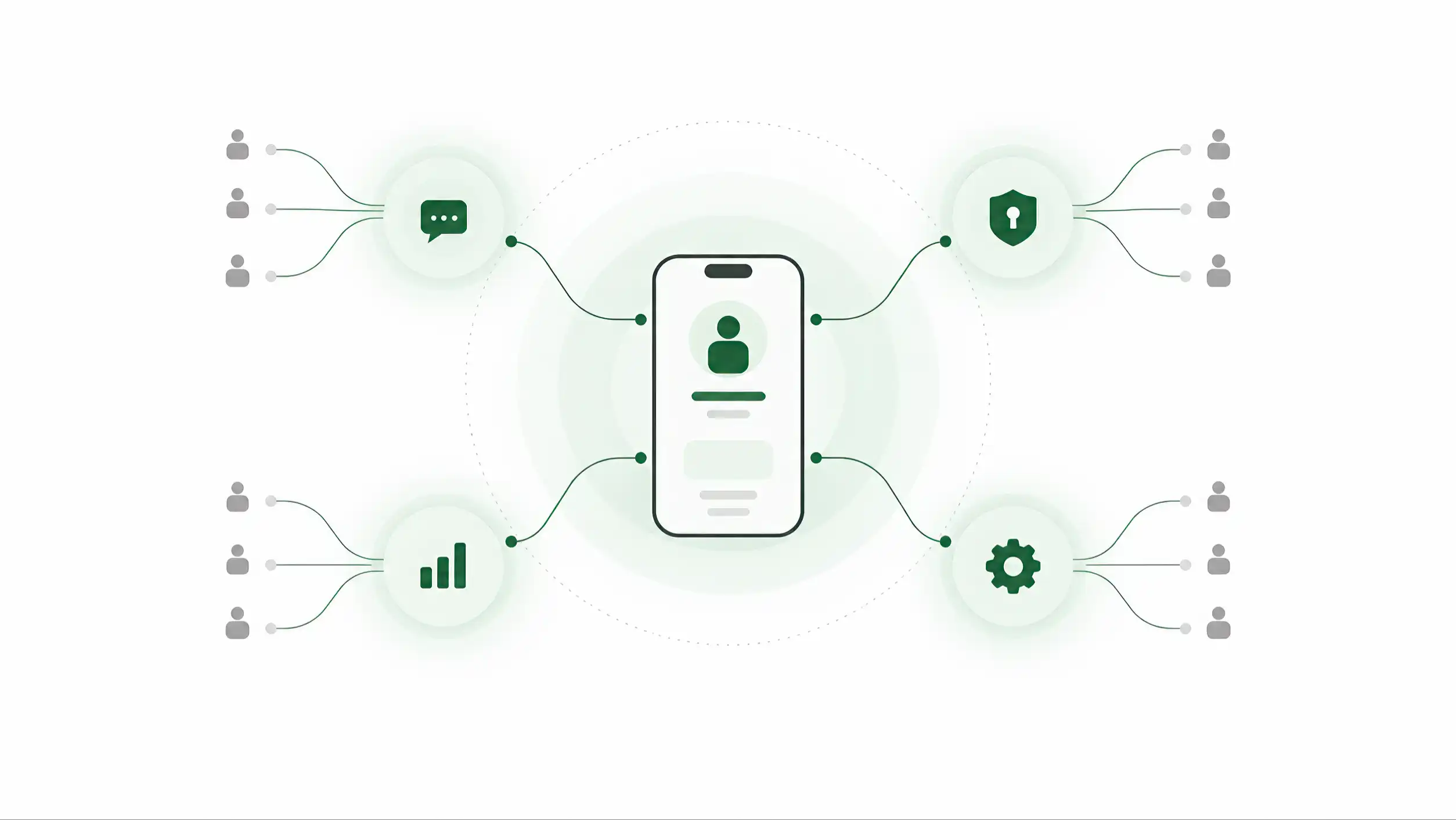
Consistency is often discussed as a branding issue, but in a multi-entry identity system it is an operational property. It affects support, permissions, analytics, maintenance, customer trust, and the speed at which the business can change safely.
Don Norman’s work on conceptual models is relevant here. People build an understanding of how a system works and use that model to predict what will happen next. Nielsen Norman Group’s consistency heuristic makes the same practical point from interface design: users should not have to wonder whether different words, situations, or actions mean the same thing. When touchpoints from one business behave as unrelated products, the customer is forced to rebuild that understanding at every entry.
Operational consistency starts with semantics. The same action should have the same meaning across entry points even if its visual placement changes. “Call,” “Book,” “Review,” “Save contact,” and “View services” should not lead to contradictory destinations. Language labels can differ naturally, but their underlying action must remain aligned. If a review stand says “Write a review” while another route sends the visitor to an internal feedback form, the difference should be intentional and visible to the team.
It also affects support. When a customer reports that “the QR stand is wrong,” support needs to know which physical item, which entry route, which profile identity, and which contextual configuration produced the page. If each point is a one-off landing page, diagnosis becomes archaeology. In a controlled architecture, the support path is simpler because the system can identify the shared core and the entry-specific layer separately.
Permissions depend on the same separation. A team member might be allowed to edit contextual content for one branch without changing the legal name or master contact information for the organization. Another role may be allowed to see analytics without changing the routing. A central identity system can support these differences because it knows which data is global and which configuration belongs to a particular touchpoint.
Consistency also protects trust during change. If a customer taps a card in the morning and scans a stand later, contradictory names, colors, services, or phone numbers create doubt even when each page looks professionally designed. The issue is not visual imperfection; it is uncertainty about which version is authoritative.
The practical test is therefore behavioral: can the business update a shared fact once, preserve intended context, diagnose a problem by entry point, and explain who is allowed to change each layer? If the answer is yes, consistency is part of the operating model. If not, the system is only visually coordinated.
Preserve source context without cloning the profile
Unifying identity does not require throwing away source context. In fact, a well-designed system should do both at the same time: preserve one coherent profile while recording which entry point created the visit.
This matters because the physical object and the customer-facing identity answer different questions. The profile tells the visitor who they reached and what they can do. The entry-source record tells the business how they arrived. A review stand on a reception desk, an NFC card used at a conference, a QR code on packaging, and a link shared in WhatsApp can all open the same identity while carrying different source context.
The cleanest approach is to give each meaningful entry point a stable source identifier or route context. That source should be attached to the visit before the visitor begins interacting with the profile. The identity itself does not need to be cloned for analytics. Instead, the analytics layer can compare behavior by source while the content layer remains shared.
This separation produces better questions. The business can ask whether a reception stand produces more review-route starts than a table stand, whether an NFC business card leads to more contact saves than a printed QR card, or whether one physical placement is still being used months after installation. Those questions depend on reliable source context, not on maintaining separate copies of the profile.
Article 06 owns the detailed event taxonomy—what counts as attention, intent, and verified outcome. The architectural point here is different: source attribution belongs to the entry layer, while action meaning belongs to the measurement layer, and identity content belongs to the profile layer. Mixing the three creates unnecessary duplication.
Source identifiers should also be deliberately scoped. A business does not need to encode every imaginable detail into the public URL. The route only needs enough stable context to distinguish the entry point at the level the business intends to analyze or manage. Location, product type, campaign, or physical-item ID may be useful; personal data or volatile labels generally should not be embedded casually just because they are available.
The source model must remain explainable. If an operator sees “entry_source=stand_23,” there should be a registry that says what stand 23 is, where it belongs, whether it is active, and which identity it currently resolves to. Otherwise the source code becomes another mystery identifier that nobody can maintain.
Preserving source context without cloning identity gives the business both consistency and observability. Customers see one current business; operators can still understand which routes are working, where a problem originated, and which physical assets remain active.
Separate object identity, route, and destination
A scalable multi-entry system becomes easier to understand when three things are kept conceptually separate: the identity of the physical or digital entry object, the route that processes the request, and the destination or representation shown to the visitor.
The object can be a card, stand, tag, sticker, package, email link, or campaign asset. It may need its own identifier so the platform knows which object produced the visit. The route is the controlled layer that receives that identifier and applies rules. The destination is what the visitor finally sees or where the visitor is sent.
Those three layers can be connected without being permanently fused. That is the key operating benefit. A stand can remain the same physical stand while the profile it opens is updated. A campaign route can stop emphasizing a temporary offer and return to the normal profile. A tag can be replaced while ownership records preserve the relationship to the same customer identity. Article 04 explains the deeper lifecycle mechanics of stable links and migration; here the focus is the operating model created by separating the layers.
An instructive industry parallel is the GS1 Digital Link ecosystem. A GS1 Digital Link URI identifies an entity, while the GS1-Conformant Resolver standard defines how that identifier can connect to one or more related online information resources or services. ADMAL does not need to implement GS1 for the architectural lesson to be useful: identity, resolution policy, and online resources can be managed as separate layers.
W3C Web architecture makes a related distinction between identifiers and representations. A URI identifies a resource; retrieving it returns a representation of that resource at that time. That separation is one reason Web systems can evolve without requiring every reference to be rewritten for every content change.
For operations, this means the platform should be able to answer three independent questions. First: which object or source generated the request? Second: which controlled identity does that object belong to now? Third: what destination or first action should be presented under the current rules? If all three answers are stored as one hard-coded URL, changing any one of them becomes unnecessarily expensive.
This layered model also improves failure handling. If the destination is unavailable, the route can fall back to the core identity rather than leaving a dead physical object. If ownership changes, the object can be reassigned according to policy without pretending that its historical source never existed. If a contextual rule is wrong, it can be corrected without replacing the underlying identity.
The architecture is successful when a physical item can remain recognizable, the identity can remain coherent, and the visitor experience can change intentionally without turning every change into a reprint or a new copy of the business.
Control link sprawl before it becomes infrastructure debt
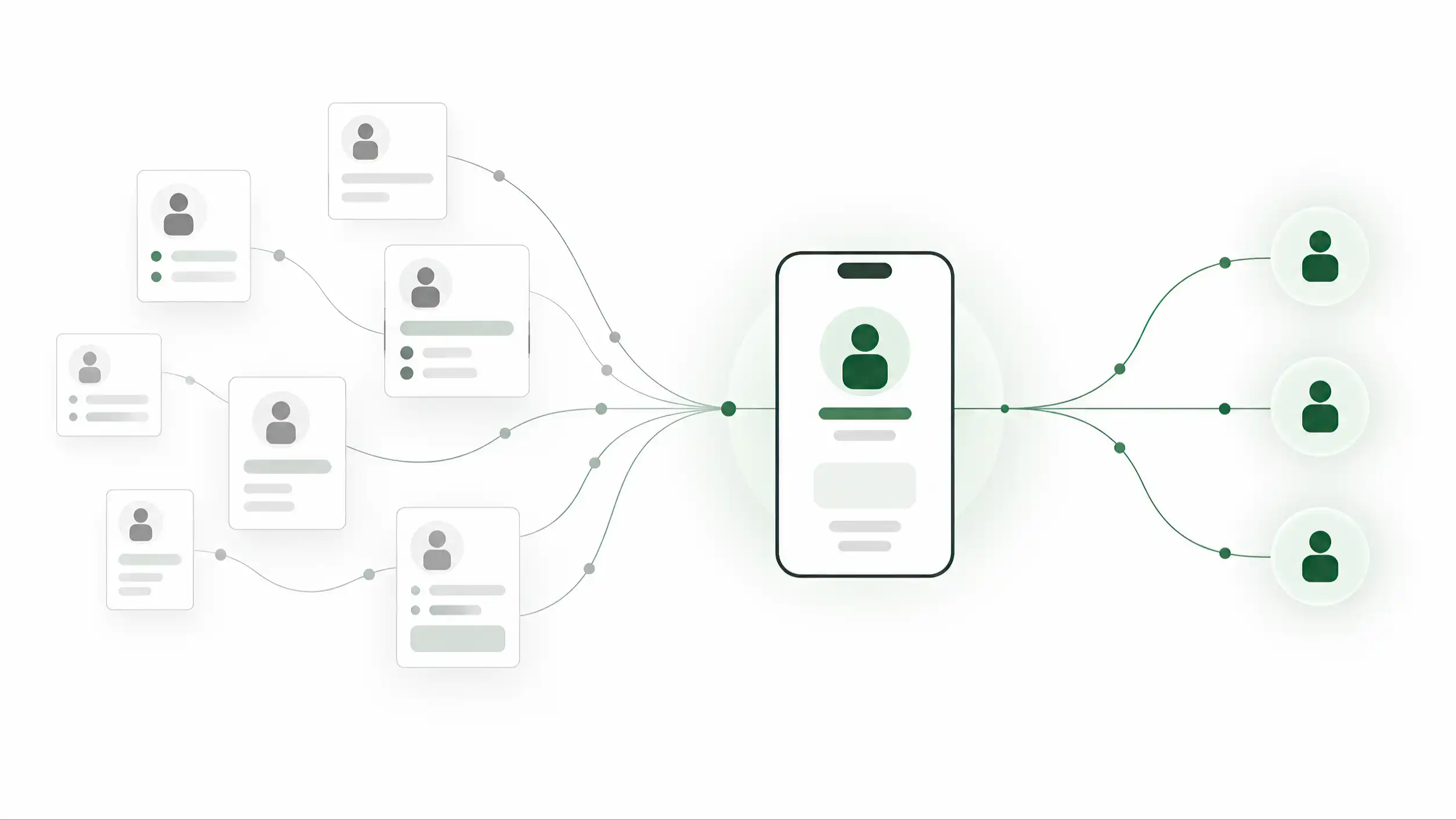
Link sprawl is an infrastructure problem disguised as a list of URLs. It starts innocently: a profile link, a booking provider, a QR-generator destination, a campaign redirect, a review URL, a shortened link, a product page, a second landing-page tool. Each solves a local need. Over time, the organization accumulates a network that nobody fully owns.
The warning sign is not simply “many links.” Some businesses legitimately need many destinations. The warning sign is that nobody can classify them. Which URL is an identifier? Which is a temporary route? Which is an external destination? Which one is printed on physical material? Which can be retired safely? Which one is the canonical customer-facing identity? If those questions require searching old chats or asking the person who originally created the QR code, the architecture is already carrying debt.
W3C Web architecture notes that arbitrary URI aliases have costs and encourages consistent use of identifiers. The practical lesson for a business identity system is to avoid creating multiple public identifiers for the same thing without a reason. A pile of aliases makes analytics, support, SEO, migration, and customer communication harder because the same identity appears under many unrelated addresses.
A controlled inventory can be simple. Classify links into a few operational types: durable identity identifiers, entry routes tied to physical objects or controlled sources, temporary campaign routes, and destination links to external services. Then define rules for each type. Durable identifiers should have strong ownership and long-term support. Physical-entry routes should map to known assets. Campaign routes should have owners and expiry rules. External destinations should be treated as dependencies that can change.
The inventory should record more than the URL. Useful fields include purpose, owner, linked identity, source type, physical placement where relevant, creation date, status, expiry or review date, and whether the route is allowed to redirect. That turns an unstructured pile into an operating register.
Do not solve sprawl by forcing every destination into one URL or by hiding complexity behind a generic shortener. The goal is not fewer characters; it is fewer uncontrolled relationships. A short link that nobody owns is still debt. A longer controlled identifier with clear ownership can be far safer.
This is also where a resolver-style architecture becomes valuable. The GS1-Conformant Resolver standard provides an industry example in which one identified entity can connect to multiple related information resources or services. The value here is the pattern: manage the relationship between identifier and destinations centrally so destinations can evolve without multiplying public identities.
The register should also expose orphaned routes: public links that still resolve but no longer have an accountable owner, active campaign, known physical asset, or documented purpose. Orphaned routes are risky because they can look healthy in uptime checks while carrying unclear business meaning. Periodic review should flag routes with no owner, no recent use, expired campaign context, or destinations that changed outside the identity system.
A mature system knows what every public route is for, who owns it, what identity it represents, and when it should be reviewed. Link sprawl stops being a mysterious legacy problem and becomes a controlled inventory.
Alt text EN
Uncontrolled link sprawl being classified into durable identity identifiers, managed entry routes, temporary campaigns and external destinations
One identity is a governance decision
Once several products, branches, campaigns, and team members depend on one identity layer, governance becomes part of the product design. Centralization creates leverage, but leverage without permissions and ownership can magnify mistakes just as quickly as it magnifies good updates.
The first governance question is ownership. Every core identity should have a clear business owner responsible for the truth of its shared facts. That does not mean one person must perform every edit. It means the system knows who is accountable for the identity and who can approve sensitive changes.
The second question is scope of permission. Editing a contextual first action for one stand is not the same privilege as changing the organization’s primary phone number. Viewing analytics is not the same privilege as unlinking a physical item. Retiring a campaign is not the same as deleting the identity. A mature system separates these capabilities so team access can be useful without giving every operator destructive control.
The third question is change history. When one central fact can affect many touchpoints, the business needs to know what changed, when, and by whom. Auditability is not bureaucratic decoration; it is the ability to explain why several cards suddenly show a new number or why a stand began routing somewhere else. For sensitive actions, approval workflows or confirmation steps may be justified.
The fourth question is lifecycle state. Entry points should have states such as active, paused, retired, replaced, or unlinked according to the product model. A retired physical item should not silently remain indistinguishable from an active one. A reassigned item should preserve enough history for support and analytics to understand the change. These states belong to operations, not to the visitor-facing content itself.
Governance also includes review. A business can periodically audit a sample of physical products and routes: scan the item, confirm the expected identity, confirm the contextual first action, verify language behavior, and check that the source registry still matches the real-world placement. This is especially important after redesigns, staff changes, branch moves, or campaign launches.
A good central identity model also makes offboarding safer. When an employee leaves or a supplier relationship ends, access can be revoked without breaking the identity or losing knowledge of the physical assets. When a new operator joins, permissions can be granted by role rather than by sharing account credentials.
The final design principle is controlled variation. One identity should centralize truth, not centralize every decision. Contextual teams can be allowed to adjust the parts they legitimately own while the platform protects the shared core. That balance is what lets a multi-entry system scale without becoming either fragmented or dangerously centralized.
One digital identity, then, is not just a page. It is an operating model: shared truth, managed entry points, preserved context, clear ownership, and rules for change.
Sources
- Information Architecture: For the Web and Beyond — Louis Rosenfeld, Peter Morville, Jorge Arango — O’Reilly Media
- Architecture of the World Wide Web, Volume One — W3C Technical Architecture Group — World Wide Web Consortium
- GS1-Conformant Resolver Standard — GS1
- The Design of Everyday Things — Revised and Expanded Edition — Don Norman — Basic Books
- 10 Usability Heuristics for User Interface Design — Consistency and Standards — Jakob Nielsen — Nielsen Norman Group