Start with purpose, not curiosity
The most reliable way to reduce unnecessary customer data is to decide what the business is trying to accomplish before deciding what the form should ask. A field is easier to justify when it supports a defined task: returning a call, preparing a quotation, delivering an order, booking an appointment, issuing an invoice, or providing after-sales support. “It might be useful later” is not the same kind of purpose. It is a reason to pause and ask whether the business is collecting information simply because the system can store it.
Purpose should be specific enough to change the design. A callback request may need a name and one contact route. A quotation may need the relevant service and enough project detail to estimate scope. Delivery details may become necessary only after the customer has actually bought something. The same person can move through several stages, but each stage does not need the full data set required by every later stage.
This is also where privacy becomes contextual rather than abstract. Helen Nissenbaum’s work on contextual integrity is useful because it asks whether information flows fit the relationship, the actors, the type of information, and the conditions under which it is shared. A home address may be completely reasonable when a purchased item must be delivered and feel disproportionate on a simple enquiry form. The data itself has not changed; the context has.
A practical field-purpose register can keep this discipline concrete. For every field, record the immediate purpose, the process that uses it, the system where it goes, whether it is mandatory or optional, and who owns that process. If a field has no current owner or no current operational use, it deserves review. If several processes claim the same field, the team can decide whether one collection point should supply the others instead of asking the customer repeatedly.
The goal is not to build the smallest possible database. It is to create a traceable relationship between what is requested and what the customer is trying to achieve. When purpose leads, the form becomes easier to explain, easier to maintain, and easier to defend when the business later asks why a particular piece of information exists in its systems.
Every field creates friction, trust cost, and responsibility
A long form can look thorough from inside the business while feeling expensive from the customer’s side. Every field consumes time, typing, attention, and decision effort. On mobile, the cost is higher because the keyboard covers part of the screen, errors are easier to make, and switching between field types can interrupt the task. A form that asks only for what is needed can therefore improve both privacy discipline and basic usability.
Not all questions have the same psychological cost. A customer may expect to give a phone number for a callback but hesitate when the same form asks for date of birth, home address, company revenue, or an identification number. The problem is not merely that a field is “sensitive.” The visitor is also evaluating proportionality: does this request make sense for the benefit I am trying to receive right now?
That evaluation affects trust. A well-designed request explains itself through context. The reason for a delivery address is obvious inside checkout. The reason for a passport number is not obvious inside a newsletter form. If the business genuinely needs an unusual field, a concise explanation can reduce ambiguity, but explanation should not become a way to justify collecting everything. The stronger design question remains whether the field is necessary for that stage.
Required and optional fields should also be treated honestly. Making a field technically optional while styling it as if it must be completed still creates pressure. Conversely, marking every field as required because it simplifies validation transfers internal convenience onto the customer. The visual hierarchy, helper text, default values, and error messages should match the real requirement.
There is an operational cost behind the interface too. Each additional field can appear later in CRM exports, emails, spreadsheets, backups, support tickets, analytics joins, or third-party integrations. The business inherits responsibility for those copies even if nobody remembers why the field was originally added. For that reason, the visible form is only the front edge of a larger data footprint.
A useful review exercise is to take a real form and force every field to answer three questions: what decision uses this, what happens if it is missing, and why is it needed now rather than later? Fields that survive those questions are easier to justify. Fields that do not are candidates for removal, postponement, or conversion from required to optional.
Alt text EN
Long generic customer form simplified into a short purpose-led form
Minimum necessary is a proportionality test, not a race to zero
Data minimisation is sometimes reduced to a slogan: collect as little as possible. That can be misleading. A business that collects too little may be unable to deliver the service, identify the correct order, respond to a request, or meet a genuine legal or contractual requirement. The stronger principle is proportionality: collect enough to accomplish the stated purpose, but do not go beyond what that purpose requires.
The wording in the UAE federal data-protection framework is useful because it connects quantity to purpose. Article 5 of Federal Decree-Law No. 45 of 2021 states that personal data should be sufficient for and limited to the purpose for which processing is carried out. The same article also links processing to a specific and clear purpose and addresses accuracy, security, and retention. This makes minimisation part of a system of controls rather than an isolated instruction to shorten forms.
W3C’s Privacy Principles reaches a similar design conclusion from a web architecture perspective: sites and other actors should restrict the data they transfer to what is necessary for users’ goals or aligned with users’ wishes and interests. The technical lesson is important. Minimisation is not only about the number of visible fields. It includes the data a website requests automatically, the identifiers it attaches to events, the information it exposes to third parties, and the granularity with which permissions are requested.
The proportionality test should consider the type of data as well as the amount. Asking for one highly revealing field may create more risk than collecting three ordinary contact fields. The same is true of combining otherwise routine data points. A name, company, device identifier, exact location, and detailed activity history can become far more revealing when joined together than when each is handled separately.
This is why “we only collect five fields” is not a meaningful privacy measure by itself. A better review asks whether each category is relevant, whether less precise information would work, whether aggregation could replace individual-level data, and whether the purpose can be achieved without linking the information back to a person.
Minimum necessary therefore sits between two failures: under-collection that breaks the service and over-collection that creates avoidable exposure. Good design finds the amount and precision that are justified by the task, then stops.

Collect progressively as the customer relationship progresses
Many businesses ask for a complete customer record during the first interaction because they know they may need those details eventually. That approach confuses future possibility with present necessity. Progressive collection separates the relationship into stages and asks for information when it becomes useful.
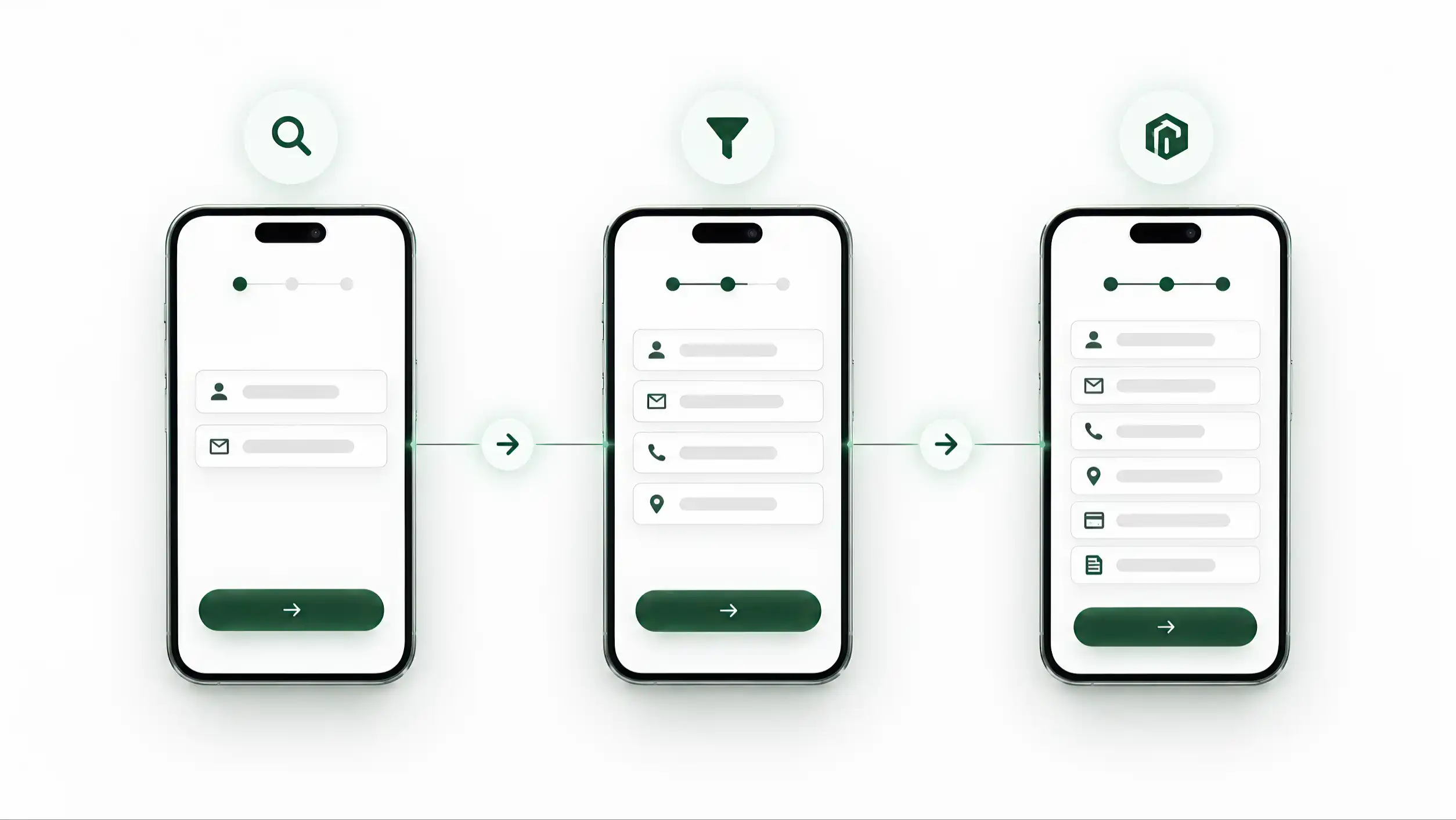
The first stage may need only a name and a contact route. If the enquiry becomes qualified, the business may ask for project specifications, preferred timing, or company information. After purchase, billing and delivery information may become relevant. After delivery, support may need an order number, product identifier, or warranty evidence. Each request appears closer to the moment when the customer can understand why it is needed.
This sequencing reduces the size of the first commitment. A visitor who only wants to ask one question does not have to complete a customer profile designed for fulfilment. A lead that never becomes an order does not leave behind delivery information that served no purpose. The business also gains cleaner data because later fields are requested only from people who have reached the stage where the information can actually be used.
Progressive collection should not become repeated questioning. Once the customer has provided a value that remains valid and the business is entitled to use it for the same process, the system should avoid asking again simply because another department uses a different screen. The purpose is to delay unnecessary collection, not to create fragmented experiences.
The process also needs a clear handoff between stages. If a sales form passes into quotation, then fulfilment, then support, the team should know which fields travel forward, which new fields become necessary, and which early fields no longer need to remain available to everyone. This is where minimisation meets access control: the right timing and the right audience are both part of reducing unnecessary exposure.
A useful visual model is not one giant form but a sequence of small justified requests. Stage one answers “Can we contact you?” Stage two answers “Can we understand and price the need?” Stage three answers “Can we fulfil the purchase?” The design becomes easier to explain because the information request grows with the relationship rather than arriving before the relationship exists.
Alt text EN
Three progressive collection stages requesting only the data needed at each stage
Analytics often needs behavior, not personal identity
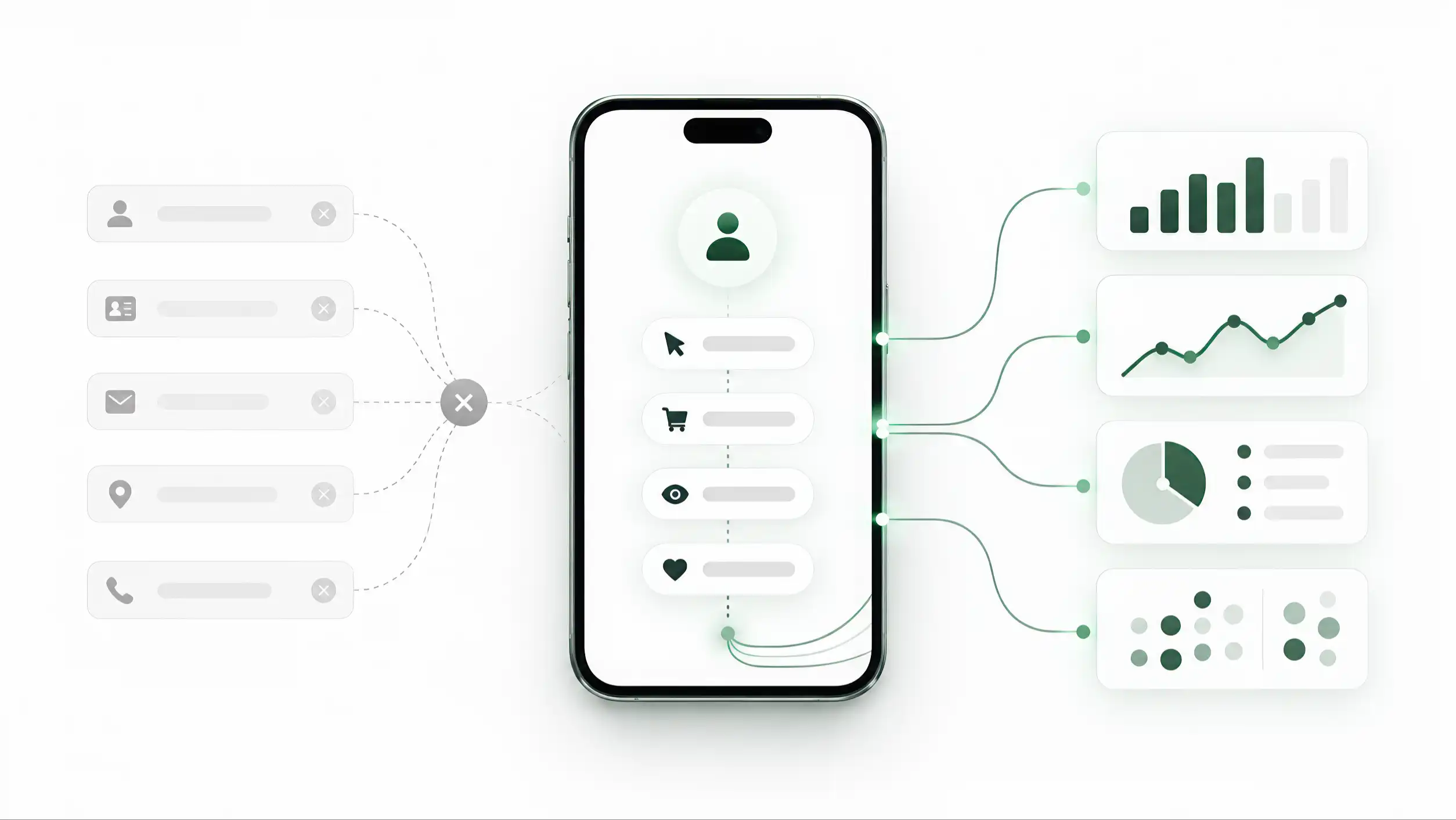
A business can learn a great deal from a digital profile without attaching a real person’s identity to every event. Opens, action counts, popular links, language selection, device categories, rough time patterns, entry source, and aggregate interaction trends can answer many product questions at group level. The important question is what decision the measurement is intended to improve.
If the goal is to learn whether visitors use the call button more than the email button, individual names are usually irrelevant. If the goal is to compare whether one profile layout leads to more contact actions, the analysis may work with aggregated events. If the business needs to follow up with a specific lead who submitted a form, identity becomes relevant to that separate operational task. These are different data needs and should not be merged automatically.
W3C’s privacy guidance makes a related distinction by encouraging systems to minimize the data transferred for users’ goals. NIST’s Privacy Framework also treats privacy as a risk-management problem: organizations should understand data processing, communicate purposes, and manage the risks those processing activities create. Both perspectives support a practical rule for analytics: do not add identity merely because the analytics tool makes it possible.
It is also important to distinguish anonymous, de-identified, pseudonymous, and merely unlabeled data. Removing a visible name does not necessarily make a dataset anonymous if a persistent identifier, exact timestamp, device details, or other attributes can still single out the same person or be joined with another dataset. The article does not need to turn every analytics implementation into a legal classification exercise, but the product team should avoid casual claims that data is anonymous when re-identification remains realistic.
For a digital-profile system, a clean separation can be valuable: behavior data supports product and performance analysis, while customer identity appears only in flows that genuinely require a person to be known, such as a contact submission or an authenticated account. This architecture reduces unnecessary linkage and makes the purpose of each dataset clearer.
The measurement standard should therefore be decision-first: what will this metric change? If the decision can be made from counts, rates, cohorts, or aggregated trends, personal identity may add risk without adding useful analytical information.
The data footprint keeps growing after the form is submitted
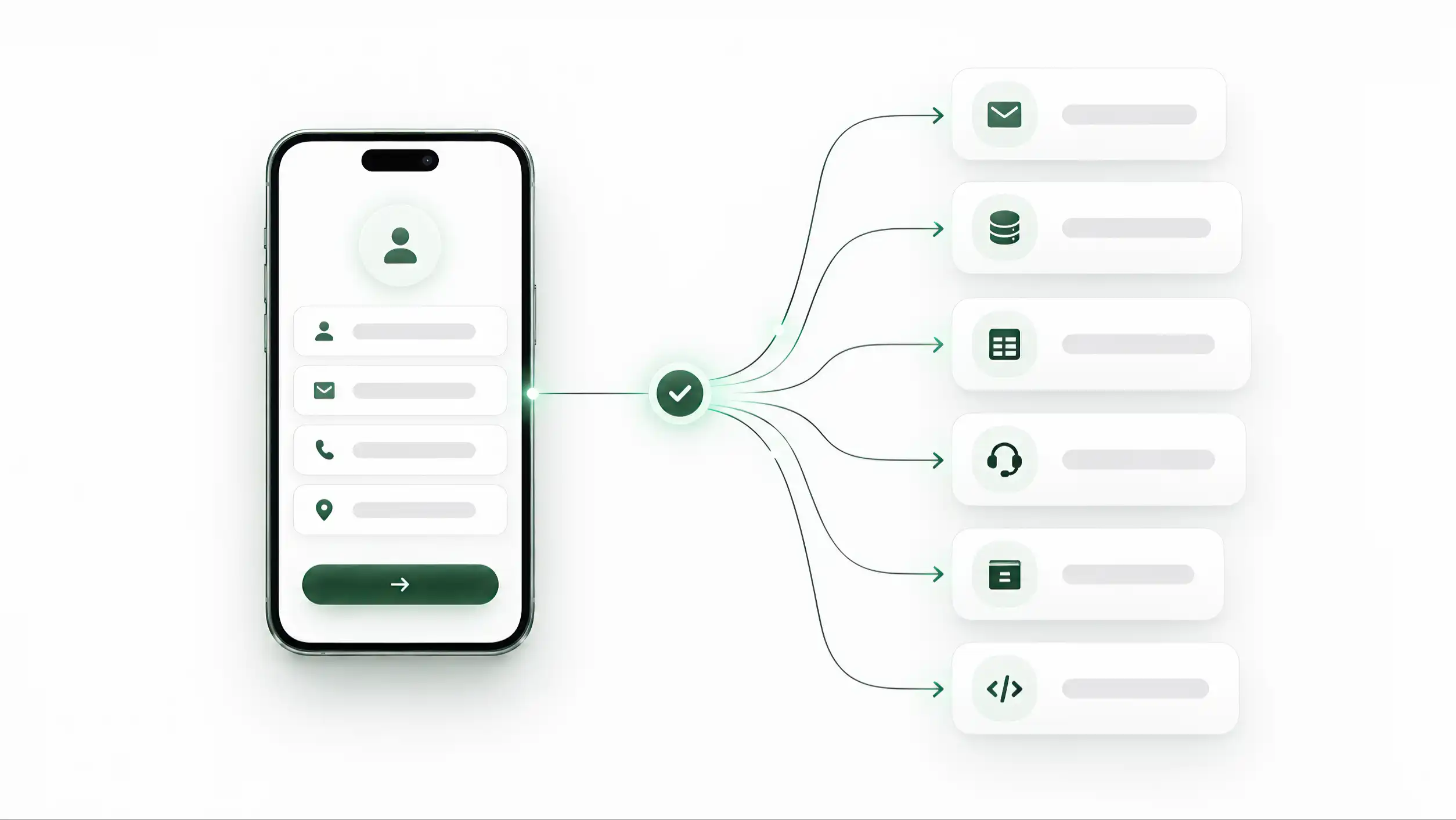
Collection is only the beginning of the responsibility. After a customer presses submit, the information may be written to a database, copied into an email, synchronized to a CRM, exported to a spreadsheet, included in a support ticket, cached in logs, backed up, or forwarded to another team. A business that reviews only the form can underestimate how many copies of the same information exist and how many people or systems can reach them.
This is where data minimisation becomes operational governance. Every additional field can increase the surface area for access control, security, retention, correction, deletion, and incident response. Privacy risk does not arise only from collection. It can also emerge through later processing, aggregation, dissemination, weak protection, and secondary use. The same field can move through several of those stages during an ordinary business workflow.
Shadow copies are a common problem. A CRM record may be governed carefully while an old CSV export remains in a shared folder. A customer service mailbox may hold the same information indefinitely. A webhook test payload may contain real customer data long after debugging is finished. A backup may be necessary, but restoring from it can reintroduce records that another system considers deleted unless the process accounts for that possibility.
A useful data-flow review follows information from intake to every downstream destination. For each copy, identify the system, owner, access group, retention rule, export capability, and deletion or correction path. The objective is not to eliminate every copy; some are necessary for resilience or business operations. The objective is to know why the copy exists and prevent forgotten copies from becoming permanent by default.
Retention should also be linked to purpose. Keeping data “just in case” for an undefined period is a different decision from retaining an invoice record because a financial process requires it. When a purpose ends, the business should know whether the record is deleted, anonymized, archived under another justified obligation, or kept for a defined reason.
The cleanest minimisation program therefore asks two questions, not one: what do we collect, and where does it go after collection? The second question often reveals more unnecessary exposure than the form itself.
UAE law turns minimisation into a concrete control, but scope still matters
For businesses operating in the UAE, Federal Decree-Law No. 45 of 2021 is an important privacy reference, but it should be used carefully rather than reduced to a generic “UAE GDPR” label. Article 2 defines the law’s territorial scope and also lists exclusions, including government data, certain health and banking information governed by other legislation, and companies or establishments in free zones that have their own special personal-data protection legislation. The correct legal regime therefore depends on the entity, processing activity, sector, and location.
For processing that falls within the federal law, Article 5 gives a direct foundation for this article’s design principle. It requires a specific and clear purpose and states that personal data should be sufficient for and limited to the purpose for which processing is performed. It also addresses accuracy, security, and the rule that data should not remain after the processing purpose has been fulfilled, subject to the law’s conditions.
Article 7 goes further into controller obligations and privacy-oriented defaults. It requires appropriate measures when defining and carrying out processing and includes default settings designed to limit processing to its intended purpose, covering the amount and type of data, the kind of processing, storage period, and accessibility. This is important because minimisation is not merely an instruction to a content writer; it reaches product defaults and system design.
The law also includes impact-assessment requirements for specified higher-risk processing under Article 21. One element of that assessment is the necessity and suitability of the processing for its purpose. Even where a particular workflow does not trigger an impact assessment, that way of thinking is useful: describe the processing, test its necessity, identify risks, and design measures that reduce them.
This article is educational rather than legal advice. A business should not infer its exact obligations from a general editorial piece, especially where a special free-zone regime or sector-specific rule may apply. Nor should it assume that practices accepted under another jurisdiction automatically satisfy UAE requirements.
The useful design takeaway is narrower and safer: purpose, proportionality, limited collection, limited accessibility, security, and retention are not only good UX ideas. They are reflected directly in the structure of the UAE federal law. Product and operations teams should therefore design data flows so those questions can be answered with evidence rather than after-the-fact explanations.
Make minimisation an ongoing operating discipline
A lean form can become bloated again six months later. New teams add fields, old campaigns end, integrations change, exports accumulate, and nobody removes the data that was needed for a process that no longer exists. Data minimisation therefore cannot be a one-time launch exercise. It needs an operating rhythm.
A practical review can begin with an inventory of active collection points: contact forms, checkout, profile forms, support flows, analytics, imports, integrations, and internal spreadsheets. For each one, map the fields to a purpose, owner, destination, access group, and retention rule. Then look for mismatches: fields with no current process, data collected before it is needed, duplicated copies, permanent access granted to temporary teams, or exports that outlived the report they were created for.
Change control matters as much as cleanup. Adding a new field should require more than changing the UI. The request should identify the purpose, whether the field is required, who will use it, where it will be stored, how long it will remain, and whether an existing field or aggregated measure could achieve the same result. Removing a field should trigger a second question: do historical copies still remain elsewhere?
NIST’s risk-management framing is useful here because privacy work becomes part of normal governance rather than a separate compliance project. The organization can assign ownership, review processing changes, monitor whether policies match reality, and respond when a product change alters the data flow. The same approach also makes future audits easier because the rationale for a field is recorded when the decision is made instead of reconstructed later.
Useful metrics are operational rather than decorative. Track the number of active collection fields with documented purposes, the number of systems receiving customer data, stale exports discovered and removed, retention rules without owners, and high-risk changes that completed review before release. These measures show whether the data footprint is becoming more understandable and controlled.
The strongest end state is not “we collect almost nothing.” It is “we can explain every material piece of customer data we collect, why we need it, when we need it, who can use it, where it travels, and when it should stop existing.” That is a more durable standard because it aligns user experience, product design, operations, security, and privacy around the same discipline. It also makes future product changes easier to review because the expected data boundary is documented before the change begins.
Sources
- Federal Decree-Law No. 45 of 2021 Concerning the Protection of Personal Data — United Arab Emirates — Official UAE Legislation platform
- Privacy Principles — World Wide Web Consortium (W3C)
- NIST Privacy Framework: A Tool for Improving Privacy Through Enterprise Risk Management — National Institute of Standards and Technology (NIST)
- Principles of personal data processing under the GDPR — European Commission
- Privacy in Context: Technology, Policy, and the Integrity of Social Life — Helen Nissenbaum — Stanford University Press